

A resistor is one of the most basic and essential components used in electronic circuits.Use our Resistor Color Code Calculator to easily calculate resistance values using color bands. Simple, accurate, and beginner-friendly tool. Its main function is to limit or control the flow of electric current. Without resistors, electronic components such as LEDs, transistors, and microcontrollers could easily get damaged due to excess current. Because of their importance, resistors are used in almost every electronic device, from small DIY projects to complex industrial systems.
Resistor Color Code Calculator
Resistors are available in many resistance values, which are measured in ohms (Ω). Common values include ohms (Ω), kilo-ohms (kΩ), and mega-ohms (MΩ). Instead of printing numbers on small resistors, manufacturers use a color band system, known as the resistor color code, to represent resistance values and tolerance.
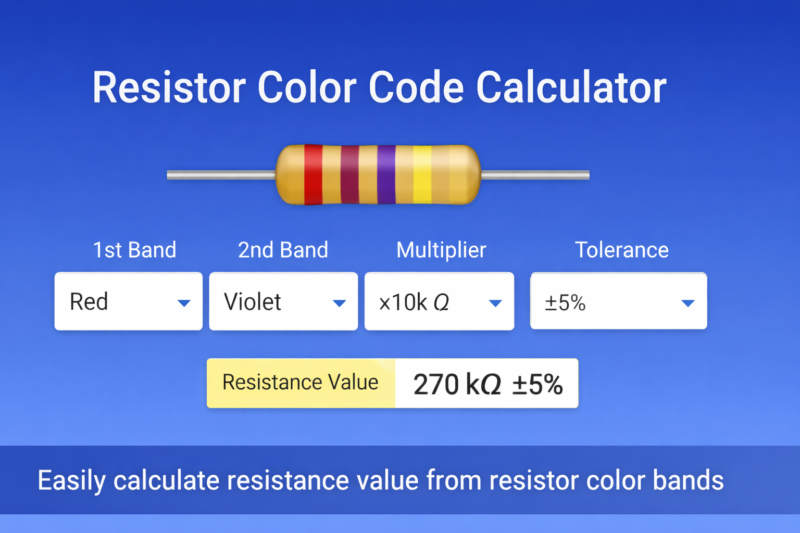
What Is a Resistor Color Code?
The resistor color code is a standardized method of using colored bands to indicate the resistance value of a resistor. Each color represents a specific number. In a typical 4-band resistor, the first two bands represent digits, the third band represents a multiplier, and the fourth band indicates tolerance.
For example:
- Brown = 1
- Red = 2
- Orange = multiplier ×1,000
- Gold = ±5% tolerance
Using this code, a resistor with Brown–Red–Orange–Gold bands has a resistance value of 12 kΩ ±5%.
Learning resistor color codes manually can be confusing for beginners, especially when dealing with multiple colors or small components. This is where a resistor color code calculator becomes extremely useful.
What Is a Resistor Color Code Calculator?
A resistor color code calculator is a simple tool that allows users to select resistor band colors and instantly calculate the resistance value. Instead of memorizing color charts or performing calculations manually, users can quickly get accurate results by choosing the colors from dropdown menus.
The calculator automatically converts color bands into:
- Resistance value (Ω, kΩ, or MΩ)
- Tolerance percentage
This makes it ideal for students, hobbyists, electronics engineers, and DIY enthusiasts.
Benefits of Using a Resistor Color Code Calculator
One of the biggest advantages of using a resistor color code calculator is accuracy. Manual calculations can lead to mistakes, especially when working under time pressure. A calculator eliminates errors and saves time.
Another benefit is ease of use. Even beginners with no electronics background can understand resistor values without confusion. This is especially helpful in learning environments, online tutorials, and practical lab work.
For web users, an online resistor color code calculator is also very convenient. It works instantly, does not require software installation, and can be used on mobile devices, tablets, or computers.
Conclusion
Understanding resistors and their color codes is a fundamental skill in electronics. While learning the color code system is important, using a resistor color code calculator makes the process faster, simpler, and more reliable. Whether you are building Arduino projects, repairing electronics, or learning basic circuits, this calculator is a valuable tool that helps you work smarter and more efficiently.